Kernex, a Rust Runtime for AI Agents
- Role
- Designer and developer
- Team
- Solo, architecture to production code
- Outcome
- Published from the first commit, solo: the first crates.io release landed the same day as the initial commit in March 2026.

A sandboxed AI agent runtime and a 12-provider CLI, built solo. 10 crates on crates.io with 12,600+ downloads as of October 2026, and a CLI that starts in about 5 ms.
Sections
Context
Python agent frameworks prototype well and fail security reviews. Teams that need AI agents touching production data cannot answer the basic compliance question: what stops this thing from reading paths it should never see? That gap defined the product.
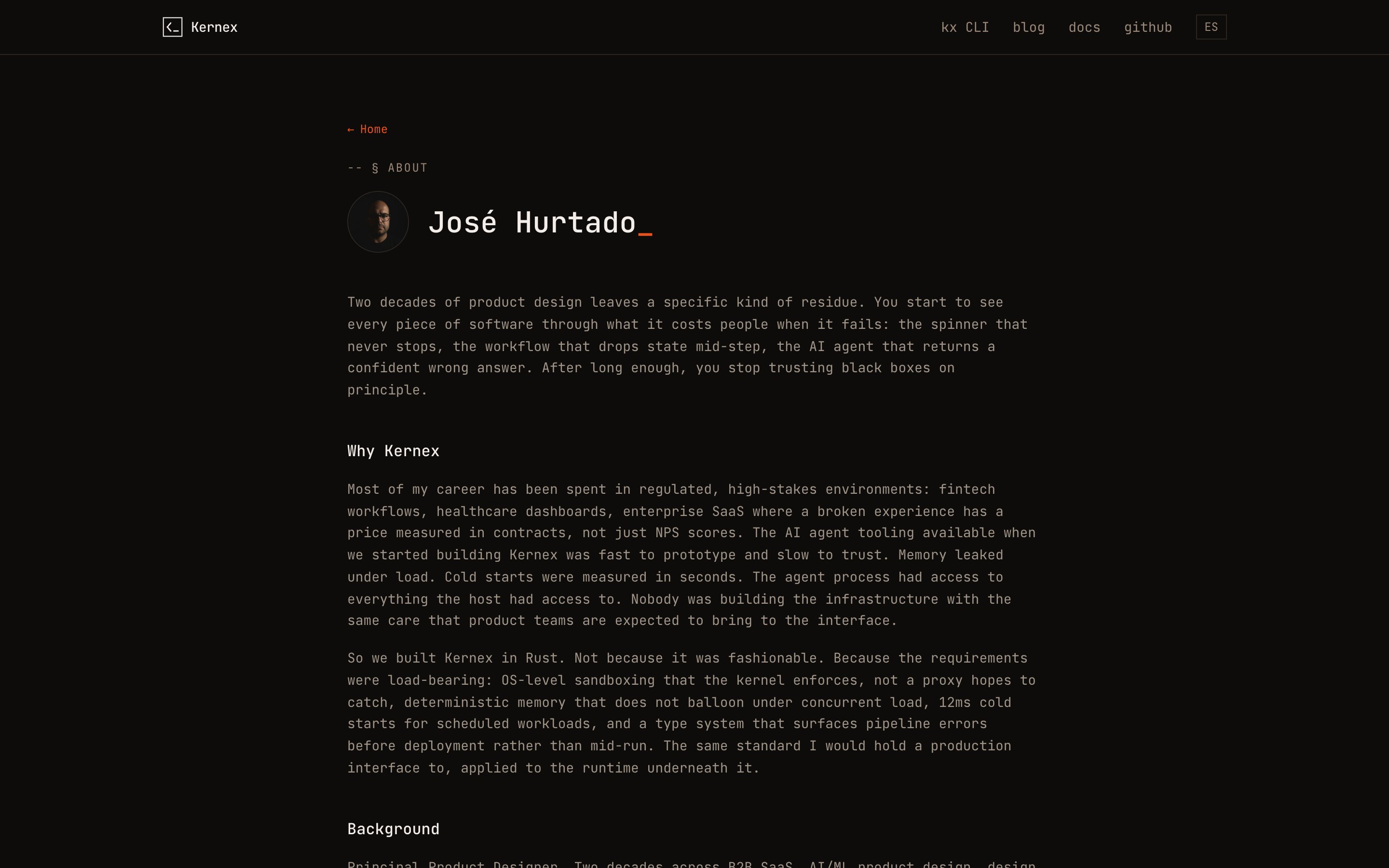
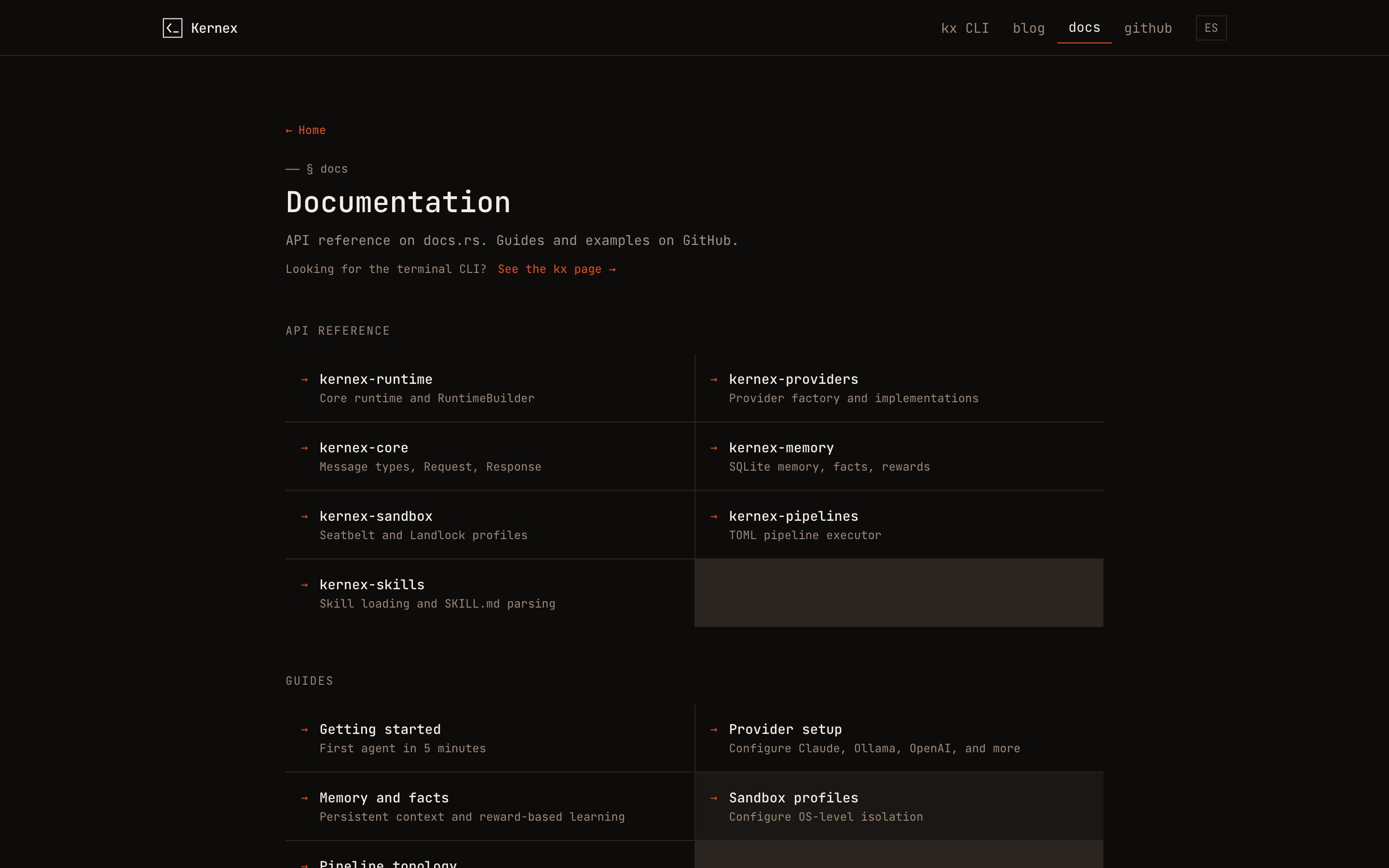
Kernex is a Rust runtime for AI agents: OS-enforced sandboxing (Seatbelt on macOS, Landlock on Linux), persistent memory, multi-provider AI, and composable pipelines. The program spans three surfaces: the runtime, the kx CLI, 10 crates between them on crates.io, and a bilingual EN/ES developer site at kernex.dev. Built solo, architecture through production code. The first crates.io release landed the same day as the first commit in March 2026; by October 2026 the crates had 149 published versions, and development continues.
Marketing a developer tool to developers who distrust marketing requires earning it first.
Key Decisions
1. Security claims verified before published
Every framework says “secure by default.” The decision here was that no security claim ships until it is asserted against a real system. CI proves three things on macOS and Linux: a sandboxed process cannot read ~/.ssh, provider keys never reach subprocesses, and an undeclared command is structurally blocked. Sandboxing is fail-closed: a host that cannot enforce isolation refuses to run tools rather than running them unprotected. A dedicated hardening release (0.9.0) extended the posture with subprocess environment isolation and network egress denied by default. kx releases ship with SHA-256 checksums and Sigstore build-provenance attestations.
The trade-off is velocity. Verification gates slow every release. The alternative, claims that a security team can falsify in an afternoon, costs the only currency a developer tool has.
2. Provider-agnostic by architecture, not by adapter sprawl
Betting the runtime on one AI provider was the fast path, and a dependency risk the whole category keeps re-learning. Kernex treats providers as a trait: 12 of them ship behind one interface, from Anthropic and OpenAI to local Ollama, with Amazon Bedrock behind an optional feature.
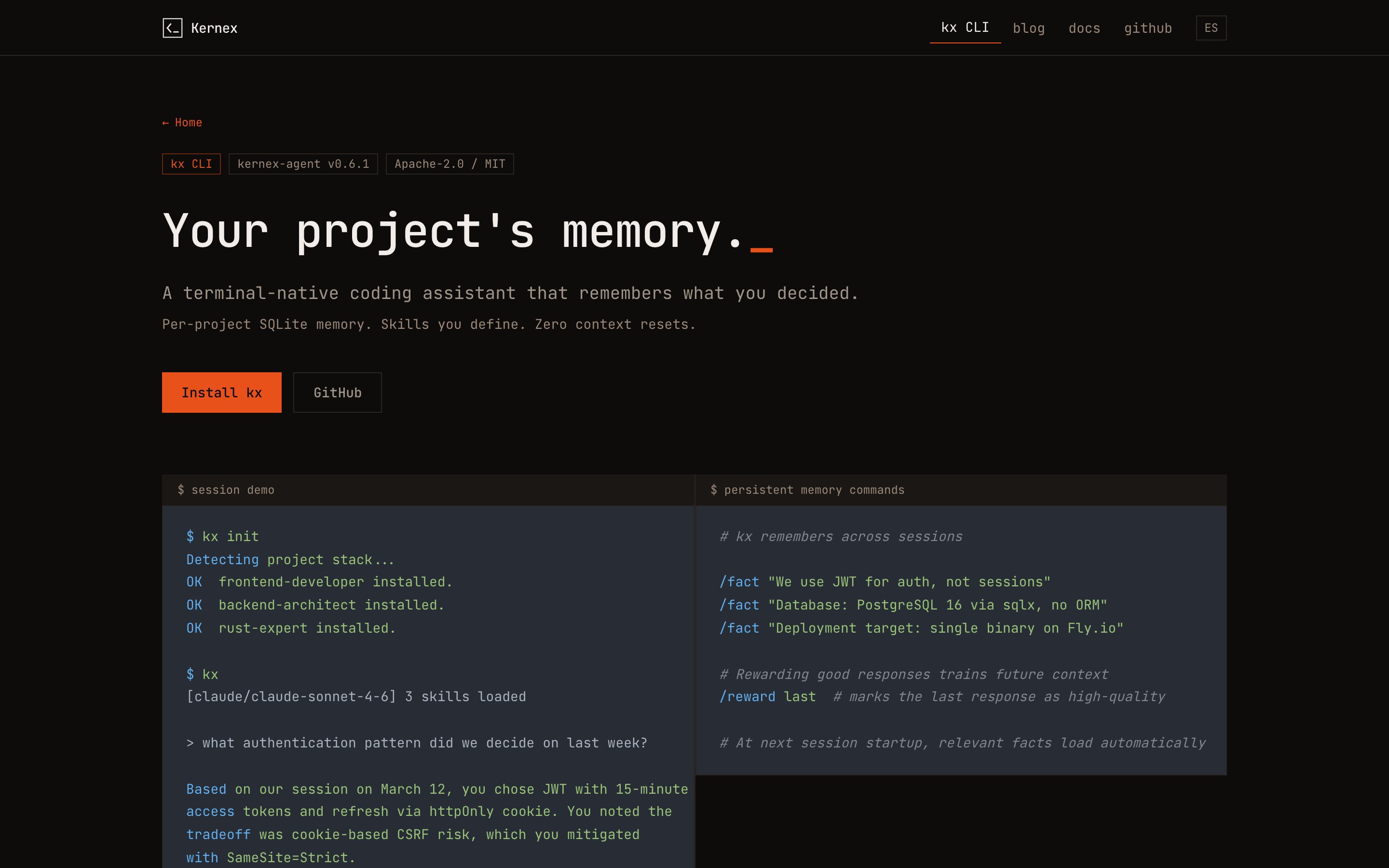
The cost discipline came from a hard budget: optional adapters sit behind Cargo feature flags so the default binary stays under 15 MiB. Breadth without bloat. The measured result: the kx CLI ships as a 12 MB release binary on Apple Silicon that starts in about 5 milliseconds. That is the difference between a tool developers script with and a tool they wait on.
3. Marketing to developers who distrust marketing
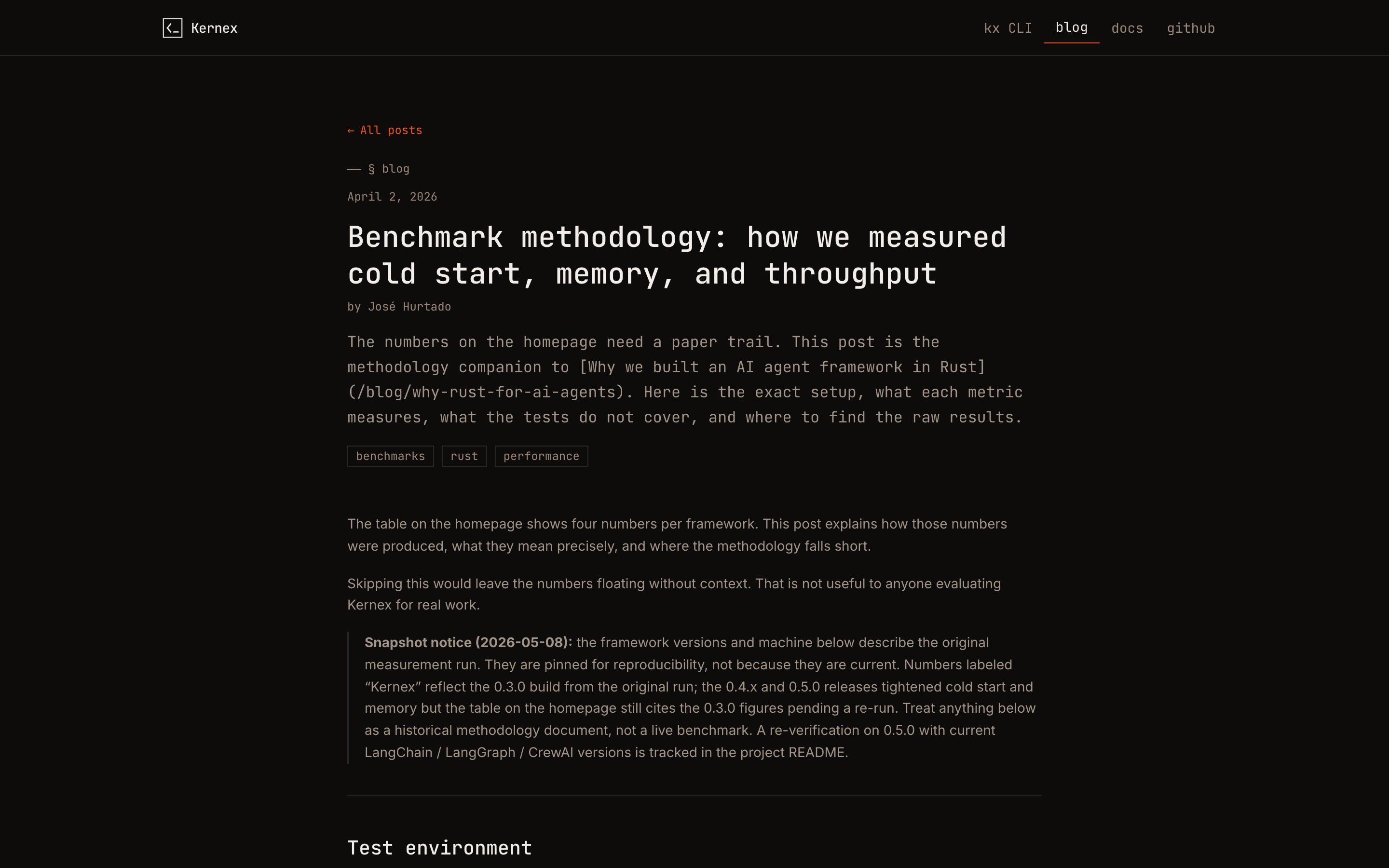
Developers read documentation before homepages and benchmark before they believe. The site leads with evidence surfaces: performance data with a published methodology, a three-layer security model explained honestly, and copy stripped of superlatives. Three developer profiles (infrastructure engineers, security-conscious platform teams, solo Rust builders) get explicit paths instead of one funnel.
Spanish ships as a first-class language across the site’s core pages, not a translation pass. The LATAM developer market is underserved by English-only tooling, and copy quality in Spanish is readable as a signal that the product was designed for that audience.
Outcome
Published from the first commit, solo: the first crates.io release landed the same day as the initial commit in March 2026. By October 2026 the crates had 149 published versions. Measured on a local release build: the kx CLI answers --version in about 5 milliseconds (median 5.68 ms) from a 12 MB binary.
- Source: kernex-dev/kernex (runtime) and kernex-dev/kernex-agent (
kx), 10 crates live on crates.io, sandbox-first, fail-closed - Adoption: 12,600+ downloads across the 10 crates on crates.io as of October 2026
kxCLI: 12 LLM providers behind one interface (plus Amazon Bedrock behind an optional feature), 21 built-in skills, releases with checksums and Sigstore provenance attestations- Benchmarks: about 17 ms to construct a runtime (criterion baseline in the repo). The kernex.dev write-up measures about 2,200 ms for LangChain, and 24 MB resident memory for ten concurrent agents
- 800+ tests in the runtime and 500+ in
kxas of November 2026, with the sandbox posture asserted in CI against real systems on macOS and Linux - Bilingual developer site in English and Spanish, with three reader paths
- In production use on several of the author’s internal workflows
Reflection
With hindsight, every release gate would have required a real-system assertion from day one, not only from the security hardening onward.